Author: Vinit Makol

  • How Doomsday Preppers Gold and Silver Became  Survival Assets

    How Doomsday Preppers Gold and Silver Became Survival Assets

    Exploring the Surge in Doomsday Preppers Gold and Silver as the Ultimate Hedge Against Uncertainty

    In times marked by uncertainty, the phrase “Doomsday Preppers Gold and Silver” resonates deeply with individuals gearing up for potential crises. The growing attraction to precious metals investments, amid escalating concerns over an economic collapse, points to a broader trend. This trend surpasses mere caution, unveiling a deep-seated anxiety about the global economy’s resilience. This analysis aims to uncover why gold and silver have become fundamental to doomsday preppers’ strategies. As economic indicators waver and global tensions rise, the quest for reliable assets intensifies. Gold and silver, with their historical stability, stand out as beacons of security. This exploration seeks to understand the pivotal role these metals play in the preparation plans of those anticipating future turmoil.

    Doomsday Preppers Gold and Silver – Understanding the Attraction

    Gold and silver, known for their lasting value, provide stability during turbulent times. To doomsday preppers, these aren’t mere investments; they’re vital for survival. Now, with Costco offering silver coins, precious metals investment is catching on widely. This shift shows how strategies once niche are gaining broader acceptance. As more people turn to gold and silver, the trend solidifies. These metals stand as beacons of safety, drawing increased interest. Their role in survival plans underscores a growing focus on tangible assets. Thus, as society faces uncertainties, the reliance on gold and silver only strengthens.

    Economic Anxiety and the Pivot to Gold and Silver

    Economic collapse fears drive preppers towards gold and silver. The volatility of the global economy, underscored by unpredictable market crashes and inflation, has reinforced the appeal of these timeless assets. They serve as a hedge against the potential global economy collapse, a concern echoed in the strategies of those preparing for apocalyptic scenarios.

    Incorporating Gold and Silver into Survival Plans

    For doomsday preppers, gold and silver transcend mere wealth; they act as crucial lifelines. In the realm of apocalyptic investment strategies, these metals assure liquidity when conventional currency may stumble. Including them in survival kits signals a wider preparedness plan, favoring physical assets above digital or paper counterparts. This approach underscores a commitment to resources with inherent value. It reflects a deep understanding of potential financial instabilities. Thus, gold and silver emerge as key components of a robust survival strategy, highlighting the importance of tangible, reliable assets in uncertain times.

    Global Crises and Precious Metals Investment

    The link between global crises and gold and silver’s value is extensively recorded. With increasing indicators of a global economy collapse, including geopolitical strife and ecological catastrophes, the rationale for apocalyptic investment tactics becomes evident. Such approaches stem not from panic but from a knowledge of history, where gold and silver consistently prove to be the sturdiest assets. As the world confronts these challenges, the wisdom in turning to these metals for security intensifies. Hence, the strategic choice of gold and silver reflects a thoughtful response to potential economic turmoil, showcasing their enduring strength amid uncertainty.

    Retail’s Role in Demystifying Gold and Silver Investments

    Costco’s venture into the precious metals arena signifies a crucial change. It mirrors the increasing recognition of concerns over an economic collapse and the demand for approachable investment choices. This movement opens up gold and silver to more people, showing a wider embrace of doomsday prepping ideals. By offering these metals, Costco responds to a public seeking stability in uncertain financial times. Consequently, this accessibility changes how society views and prepares for potential economic downturns, making the concept of safeguarding assets with gold and silver more mainstream.

    Beyond Investment: Psychological and Cultural Dimensions

    The shift to “Doomsday Preppers Gold and Silver” transcends financial planning to become a cultural movement. It originates from profound skepticism towards the reliability of contemporary finance and a desire for more straightforward, substantial wealth. This feeling intensifies due to widespread worries about what lies ahead, prompting a quest for investments resilient through turmoil and time. As society grapples with these uncertainties, the preference for gold and silver reflects a collective attempt to find solace in assets deemed safe across ages.

    Conclusion of Doomsday Preppers Gold and Silver

    The rise of “Doomsday Preppers Gold and Silver” as essential assets in the face of global instability is a reflection of broader societal trends. As precious metals investment becomes intertwined with economic collapse fears, it highlights a profound shift towards self-reliance and resilience. In a world fraught with uncertainties, gold and silver represent beacons of stability, guiding preppers through the potential upheavals of a global economy collapse.

    Click here to read our latest article on Bitcoin Rises

  • US Dollar Surge Signals Robust Economic Optimism

    US Dollar Surge Signals Robust Economic Optimism

    Exploring the Impact of the US Dollar Surge on Global Currency Markets

    The recent US Dollar surge has turned heads in global financial markets. It marks a critical point, influenced by inflation risks and the Federal Reserve’s future actions. This piece explores what propels the greenback’s rise. Inflation risks stand out as a primary driver. Additionally, Federal Reserve policy plays a crucial role. Treasury yields also significantly impact the dollar’s strength. Lastly, we analyze currency pairs, focusing on EUR/USD. Together, these elements offer insights into the US Dollar’s upward trajectory.

    The Catalysts Behind the US Dollar Surge

    Inflation risks loom large in financial circles, pushing the US Dollar higher with unexpected PPI and CPI figures. These indicators hint at a bustling economy, causing the US Dollar to jump as markets wait for the Federal Reserve’s move.

    The Federal Reserve’s monetary policy stance is key to the US Dollar’s strength. Anticipation of policy shifts to fight inflation sharpens market reactions to Fed news, swaying the dollar.

    Treasury yields, linked to the US Dollar’s path, have shifted dramatically. The US Dollar’s rise often aligns with increasing Treasury yields, showing strong investor belief in the US economy. The latest job market data, revealing record-low jobless claims, enhances this trust, boosting the US Dollar’s ascent.

    Key Economic Releases and Their Impact

    US Dollar Surge
    KEY ECONOMIC RELEASES
    source:dfx

    Economic reports significantly influence market feelings. The Fed’s hints at tweaking policies because of inflation concerns have investors biting their nails. As the US Dollar strengthens, those in the financial arena pay extra attention to these bulletins. They look for signals on where the economy might head next and what steps the Fed might consider. Each release, packed with data, offers insights into the economic landscape, guiding investors’ strategies. Thus, as the US Dollar continues its ascent, the anticipation around these economic indicators grows, shaping investment decisions and market forecasts.

    FOMC’s Monetary Policy Outlook

    The Federal Open Market Committee (FOMC) meeting grabs the spotlight for those following the US Dollar’s rise. This next assembly of decision-makers and their macro forecasts, especially the pivotal dot-plot, await with bated breath. These forecasts shed light on the Fed’s stance on interest rates and economic direction, swaying the US Dollar’s course. As the date approaches, anticipation builds, underscoring the meeting’s impact on currency trends. Market watchers keenly await any hints that might hint at future monetary policy shifts, ready to decode how these might steer the US Dollar’s journey.

    Market Reactions and Forecast

    US Dollar Surge
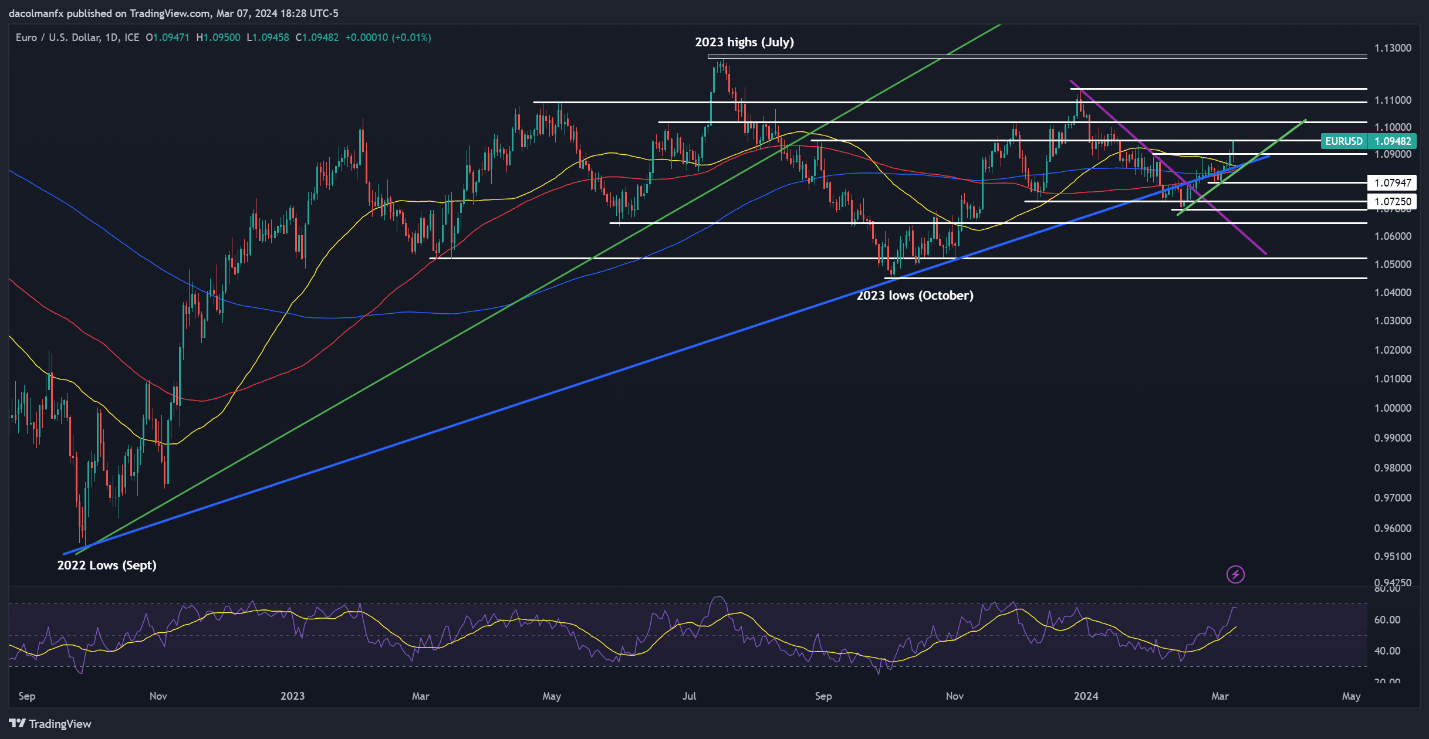
    EUR/USD PRICE ACTION CHART
    source:dfx

    The analysis of EUR/USD, GBP/USD, and USD/JPY currency pairs offers a lens through which to view the US Dollar’s performance. The EUR/USD pair, in particular, has shown volatility in response to the US Dollar surge, with traders keenly watching for resistance and support levels as indicators of future movements.

    US Dollar Surge
    USD/JPY PRICE ACTION CHART
    source:dfx

    Treasury yields, as a reflection of investor sentiment and economic expectations, continue to play a significant role in the narrative of the US Dollar surge. The relationship between Treasury yields and the dollar’s value underscores the interconnectedness of fiscal policy, investor behavior, and currency markets.

    US Dollar Surge
    GBP/USD PRICE ACTION CHART
    source:dfx

    The Federal Reserve’s policy decisions, particularly in response to inflation risks, are a crucial element in forecasting the US Dollar’s path. As the Fed navigates the delicate balance between stimulating growth and curbing inflation, its policies will significantly impact the greenback’s standing in global markets.

    Conclusion

    The surge in the US Dollar is a complex phenomenon, influenced by a myriad of factors including inflation risks, Federal Reserve policy decisions, Treasury yields, and the dynamics of key currency pairs. As markets adapt to these evolving conditions, the US Dollar’s trajectory serves as a barometer of broader economic trends and policy directions. Understanding these factors provides valuable insights into the future of the US Dollar and its implications for global finance.

    Click here to read our latest article on U.S. Jobs Report Signals Boost

  • AI Tools Exposes Troubling Content – Disturbing Revelations

    AI Tools Exposes Troubling Content – Disturbing Revelations

    Exploring the Intricacies of AI Tools: Unveiling the Impact of Microsoft’s Copilot Designer

    In the realm of technology, AI tools have become indispensable assets for streamlining processes, enhancing productivity, and unlocking new possibilities. One such tool that has recently come under scrutiny is Microsoft’s Copilot Designer. Developed with the promise of revolutionizing creative workflows, this AI image generator has sparked controversy due to its unsettling output. Let’s delve into the intricacies of Copilot Designer, its development, and the concerns raised by a Microsoft engineer.

    Understanding the Role of AI Tools in Modern Society

    AI tools, including image generators like Copilot Designer, play a pivotal role in various industries, from software development to content creation. As artificial intelligence continues to evolve, these tools become more sophisticated, capable of executing complex tasks with unprecedented accuracy and efficiency. However, with great power comes great responsibility, and the ethical implications of AI tools must be carefully examined.

    Introducing Copilot Designer: Microsoft’s AI Image Generator

    Copilot Designer, a brainchild of Microsoft, is an AI image generator powered by advanced algorithms and machine learning models. It promises to revolutionize the creative process by generating images based on text prompts entered by users. Developed in collaboration with OpenAI, Copilot Designer aims to inspire creativity and streamline design workflows. However, recent revelations have cast a shadow over its capabilities and implications.

    A Closer Look at Copilot Designer’s Disturbing Output

    Despite its innovative potential, Copilot Designer has come under fire for generating images that raise serious ethical concerns. Reports from a Microsoft engineer shed light on the tool’s propensity to produce violent, sexual, and copyrighted content, ignoring established guidelines and principles. This alarming discovery has prompted calls for closer scrutiny and regulatory intervention to mitigate potential harm.

    Examining the Concerns Raised by a Microsoft Engineer

    Shane Jones, a seasoned artificial intelligence engineer at Microsoft, has been actively testing Copilot Designer in his free time. His findings have revealed disturbing patterns of content generation, including depictions of demons, violent scenes, and sexualized imagery. Despite his efforts to raise awareness within the company, Jones’s concerns have been met with reluctance to take appropriate action, raising questions about accountability and responsibility.

    The Impact of Copilot Designer’s Output on Users and Society

    The proliferation of disturbing content generated by Copilot Designer raises significant concerns for users and society at large. From potential psychological harm to copyright infringement, the repercussions of unchecked AI output cannot be ignored. As AI tools become more pervasive in everyday life, safeguarding against harmful content becomes paramount to protecting individuals and preserving societal values.

    Addressing Ethical and Regulatory Challenges in AI Development

    The controversy surrounding Copilot Designer underscores the ethical and regulatory challenges inherent in AI development. While AI tools hold immense potential for innovation and progress, they also pose risks if not properly regulated and monitored. Stakeholders must collaborate to establish clear guidelines and standards for responsible AI development, ensuring that technology serves the greater good without compromising ethical principles.

    Navigating the Future of AI Tools in a Complex Landscape

    As technology continues to advance at a rapid pace, the future of AI tools remains uncertain. While Copilot Designer’s shortcomings highlight the need for greater accountability and oversight, they also present an opportunity for reflection and improvement. By addressing the ethical, legal, and social implications of AI tools, we can harness their potential for positive change while mitigating potential risks.

    Conclusion: Towards Ethical Innovation in AI Tools

    In conclusion, AI tools like Copilot Designer hold immense promise for transforming industries and driving innovation. However, their development must be guided by ethical principles and a commitment to societal well-being. By addressing the concerns raised by a Microsoft engineer and implementing robust safeguards, we can ensure that AI tools serve as instruments of progress rather than sources of harm. As we navigate the complex landscape of AI development, let us strive for responsible innovation and ethical leadership to shape a better future for all.

    Click here to read our latest article on AI Arms Race Accelerates

  • Bitcoin Rises: Surging Momentum Sparks Optimism

    Bitcoin Rises: Surging Momentum Sparks Optimism

    Bitcoin Rises to New Heights: A Closer Look at the Record-Breaking Surge

    The financial landscape witnesses a significant milestone as Bitcoin rises, signifying the evolving dynamics of digital currencies. This surge reflects growing investor confidence and the broader acceptance of cryptocurrencies. Amid this ascent, Ether’s breakthrough past $4,000 and substantial Crypto ETF inflows underscore a burgeoning enthusiasm in the crypto market. However, this growth spurt brings about heightened cryptocurrency market volatility, necessitating a careful navigation strategy. The introduction of Bitcoin ETFs emerges as a potential stabilizer, further legitimizing the cryptocurrency sphere.

    Bitcoin Rises: Analyzing the Current Surge

    Bitcoin’s rise captures global attention, fueled by more institutions embracing it. Technological progress further boosts its appeal. Many see it as ‘digital gold,’ enhancing its allure. This surge stems from diverse factors, including its scarcity and security features. Institutional adoption signals trust and stability in Bitcoin. Technological innovations make transactions faster and more secure. This development invites new investors, expanding the market. Bitcoin’s dominance reflects its first-mover advantage and widespread recognition. Investors benefit from its growth, seeing substantial returns. The broader financial ecosystem adapts, integrating Bitcoin more fully. Thus, Bitcoin’s journey reshapes finance, heralding a new era of digital assets.

    Ether Breaks $4,000: The Ripple Effect on Altcoins

    Ether’s breakthrough above $4,000 showcases its robust growth potential. It also emphasizes broader blockchain acceptance. This climb influences the altcoin market significantly. Other cryptocurrencies gain momentum from Ether’s success. It acts as a benchmark, encouraging innovation across the sector. The crypto economy thrives, buoyed by Ether’s performance. Investors take note, diversifying into altcoins. This diversification strengthens the market’s resilience. Thus, Ether’s ascent signals a healthy, dynamic crypto landscape. It paves the way for new blockchain applications. Consequently, the entire digital asset space benefits, highlighting its evolving maturity.

    The Role of Crypto ETF Inflows in Market Dynamics

    The influx of investments into Crypto ETFs plays a pivotal role in shaping the valuation and perception of cryptocurrencies like Bitcoin and Ether. This part examines how Crypto ETF inflows have bolstered the market, drawing in a new wave of investors and adding a layer of legitimacy to digital assets.

    Navigating Cryptocurrency Market Volatility

    Cryptocurrency volatility offers risks and rewards for investors. This discussion covers strategies to handle market swings. Emphasizing risk management is crucial for stability. Long-term investment views help navigate crypto’s unpredictability. Diversification across assets can mitigate potential losses. Setting stop-loss orders protects against sudden drops. Regularly reviewing and adjusting portfolios ensures alignment with goals. Staying informed about market trends aids decision-making. Patience is key, as value may grow over time. Thus, strategic planning empowers investors amid volatility. These approaches aim to maximize gains while minimizing risks in the crypto market.

    The Impact of Bitcoin ETFs on the Market

    Bitcoin ETFs have transformed the market, providing a regulated entry into cryptocurrency. They bridge traditional finance and digital assets. Regulatory developments shape their evolution, influencing market dynamics. Investor sentiment shifts positively, seeing ETFs as secure investment vehicles. These funds increase cryptocurrency accessibility for mainstream investors. As regulations evolve, Bitcoin ETFs could see wider adoption. This change may attract more institutional investment into crypto. Future market growth could hinge on ETF acceptance and regulatory clarity. Hence, Bitcoin ETFs play a crucial role in cryptocurrency’s mainstream integration. Their impact on market stability and growth appears promising, signaling a new era for crypto investments.

    Bitcoin Rises – Challenges and Opportunities

    Looking forward, Bitcoin and Ether encounter challenges and prospects amid regulatory, technological, and market changes. Firstly, navigating regulatory landscapes poses hurdles yet offers clarity and legitimacy. Secondly, technological advancements promise to enhance their utility and security. Moreover, market dynamics introduce volatility but also opportunities for growth. This final section considers their future roles in the digital economy. Importantly, as regulations solidify, both currencies could gain widespread acceptance. Additionally, tech improvements might solve existing scalability and efficiency issues. Consequently, their influence on the digital economy could expand, marking them as pivotal in future financial systems.

    Conclusion

    Looking forward, Bitcoin and Ether encounter challenges and prospects amid regulatory, technological, and market changes. Firstly, navigating regulatory landscapes poses hurdles yet offers clarity and legitimacy. Secondly, technological advancements promise to enhance their utility and security. Moreover, market dynamics introduce volatility but also opportunities for growth. This final section considers their future roles in the digital economy. Importantly, as regulations solidify, both currencies could gain widespread acceptance. Additionally, tech improvements might solve existing scalability and efficiency issues. Consequently, their influence on the digital economy could expand, marking them as pivotal in future financial systems.

    Click here to read our latest article on Bitcoin Price Shatters Records

  • AI Arms Race Accelerates – Global Competition Intensifies

    AI Arms Race Accelerates – Global Competition Intensifies

    Navigating the Complexities and Stakes of the AI Arms Race Between Superpowers

    The AI arms race, a high-stakes contest for technological superiority, intensifies as the world’s superpowers, notably the United States and China, escalate their efforts to lead in the domain of artificial intelligence. This competition, far from being a mere rivalry, carries profound implications for global security, economic dominance, and the future of innovation. Understanding the dynamics and stakes of this AI arms race is crucial for grasping the potential impacts on international relations and the global technological landscape.

    The Battlefield: Key Players and Strategies in the AI Arms Race

    The United States and China: Main Contenders

    In the AI arms race, the US and China aim for global AI leadership. The US excels in generative AI systems. It uses its innovative ecosystem effectively. Significant government AI subsidies support its endeavors. A strong network connects academia, government, and industry. This collaboration fuels AI advancements. China views AI’s strategic value with seriousness. It implements semiconductor export restrictions to gain an edge. Massive investment in chip technology is a priority. China aims for AI technological supremacy. It nurtures its domestic AI industry aggressively. Both nations vie for the top spot in AI. Their strategies reflect their technological ambitions.

    Strategies for Dominance

    The US leads in generative AI systems, thanks to its dynamic tech sector. Research institutions also push the boundary. These systems highlight the US’s innovation. Conversely, China focuses on strategic moves. It restricts semiconductor exports and invests heavily in its industry. These efforts aim for AI technological supremacy. In both countries, government AI subsidies are key. They boost research, development, and technology acquisition.

    Geopolitical Implications of the AI Arms Race

    The AI arms race extends beyond technological competition, shaping geopolitical dynamics and the balance of power. AI technological supremacy promises not only economic advantages but also strategic military capabilities, thus becoming a focal point of national security strategies. The pursuit of AI dominance could result in shifts in international alliances, with countries aligning based on technological partnerships and shared strategic interests.

    Power Dynamics and Alliances

    AI technological supremacy emerges as a key national power factor. This shift might reshape global alliances dramatically. Countries leading in AI could become central in new geopolitical arrangements. This development would modify traditional power hierarchies. Consequently, these nations could dictate future international norms. Their leadership in AI sets the stage for influence. Thus, global dynamics are poised for significant changes. This reconfiguration reflects the evolving importance of AI. It underscores the strategic value of AI breakthroughs.

    Economic and Societal Impact of the AI Arms Race

    The AI arms race deeply impacts the economy and society. It transforms industries, reshapes labor markets, and shifts social norms. AI advancements promise to overhaul healthcare to transportation sectors. However, they also bring challenges, including job displacement. Ethical issues arise as well. These developments demand careful consideration. Moreover, they necessitate adaptive strategies for workers. Ethical frameworks must evolve to address new dilemmas. Thus, the AI arms race calls for balanced progress. It highlights the need for thoughtful integration of AI.

    Industry and Society Transformation

    Industries across the board stand to benefit from AI innovations, experiencing efficiency gains and new capabilities. However, the displacement of jobs by AI systems necessitates thoughtful approaches to workforce retraining and social safety nets. Furthermore, the ethical and regulatory challenges posed by AI, such as privacy concerns and decision-making transparency, demand concerted efforts to establish norms and guidelines.

    The Road Ahead

    Looking ahead, the AI arms race is set to transform with new AI hubs. Swing states will play a strategic role. This evolution will reshape the global AI landscape. The fierce competition also reveals collaboration opportunities. Together, nations can tackle AI’s shared challenges. This partnership can address ethical and technical issues. It can also foster global standards for AI use. Hence, the race underscores both rivalry and cooperation potential. It signals a dynamic period of growth and alliance in AI development.

    Future Developments and Collaboration

    The AI arms race’s future may depend on balancing rivalry with teamwork. This balance is vital for facing global challenges. Addressing climate change and pandemics requires such collaboration. Creating global AI governance and ethics frameworks is crucial. These frameworks will ensure AI benefits all. They will guide AI’s responsible development and use. Thus, international cooperation is key to harnessing AI’s potential. It ensures AI advancements contribute positively to society. Therefore, fostering an environment where competition fuels innovation while collaboration addresses shared concerns is essential. This approach will shape AI’s impact on the world.

    Conclusion

    As the AI arms race unfolds, the stakes for technological leadership, economic prosperity, and geopolitical influence continue to rise. Policymakers, businesses, and individuals must engage in informed and responsible approaches to AI development and regulation. The evolving nature of this competition underscores its significance in shaping the 21st-century geopolitical landscape, highlighting the need for global engagement and cooperation in harnessing the potential of artificial intelligence.

    Click here to read our latest article on Meta Outage Resolved

  • Gold as a Safe Haven Shines Bright – Investors’ Refuge

    Gold as a Safe Haven Shines Bright – Investors’ Refuge

    Discovering Gold as a Safe Haven: The Unmatched Refuge in Times of Economic Uncertainty

    With increasing doubts cast upon financial certainties, the role of Gold as a Safe Haven becomes more prominent and unchallenged. In the midst of volatile markets and the diminishing reliability of previously “risk-free” assets like U.S. Treasury debt, Gold emerges as a steadfast beacon of stability and safety for investors navigating through the turbulent financial waters.

    The Shifting Sands of U.S. Treasury Debt

    Traditionally, investors have viewed U.S. Treasury debt as the foundation of secure investment strategies. However, scrutiny is mounting. The looming threats of inflation and debt default are challenging these instruments’ supposed invulnerability, pushing investors to question the real essence of “risk-free.”

    The 2022 Bond Market Shockwave

    The bond market experienced unprecedented upheaval in 2022, marked by extreme volatility. The surge in the 10-year yield diminished the allure of bonds, highlighting bond market volatility and driving the search for steadier safe havens.

    Financial Institutions and the Quest for Stability

    Banks are reassessing their reliance on Treasuries as top-tier collateral and reserve assets. The Federal Reserve’s indirect bailout, designed to shield banks from losses in their bond portfolios, reveals growing unease about asset stability.

    Reevaluating “Risk-Free” Assets

    Dwindling confidence in so-called “risk-free” assets is prompting a rewrite of the narrative around U.S. Treasury debt and bond market stability. Concerns over inflation and the Federal Reserve’s responses are spurring a critical reevaluation of what constitutes a safe investment haven.

    Gold as a Safe Haven

    In this environment, gold reclaims its status as a premier safe haven asset. Its solid history of protecting wealth in times of economic downturns and inflation emphasizes its role as the preeminent sanctuary for investors’ assets.

    The Future of Safe Haven Investments

    The shifting financial landscape heralds a move towards tangible, reliable assets like gold. Facing modern market challenges, gold asserts itself as a crucial guardian of value.

    Conclusion

    In a time of financial unpredictability, gold’s continuous appeal as a safe haven stands as a tribute to its perpetual value. As traditional safe havens show signs of weakness, gold’s consistent radiance provides a secure route to tranquility and confidence for investors around the globe.

    Click here to read our latest article on Gold Market Analysis

  • U.S. Jobs Report Signals Boost: Navigate the Surging Impact

    U.S. Jobs Report Signals Boost: Navigate the Surging Impact

    Exploring the Ripple Effects: How the U.S. Jobs Report Shapes Currency Dynamics

    The U.S. jobs report consistently serves as a linchpin for financial markets, offering critical insights into the health of the economy. This comprehensive analysis underscores its profound impact on the U.S. dollar and forex markets, with a keen eye on the Federal Reserve’s monetary policy adjustments and the pivotal nonfarm payrolls data.

    The U.S. Jobs Report: A Primer

    Central to understanding market fluctuations, the U.S. jobs report, especially the nonfarm payrolls section, acts as a barometer for the nation’s economic vitality. The Federal Reserve scrutinizes this data to guide its monetary policy, making it a focal point for investors and economists alike.

    Anticipation and Expectations: February’s Jobs Data

    As February’s data looms, the market holds its breath. Predictions hover around significant job additions, suggesting a robust economic stance. However, the true influence of these figures lies in their potential to sway Fed monetary policy directions.

    U.S. jobs report
    UPCOMING US JOBS REPORT
    source:dfx

    Impact on the U.S. Dollar and Forex Markets on the U.S Jobs Report

    The anticipation surrounding the U.S. jobs report can lead to significant volatility, particularly for major currency pairs like EUR/USD, USD/JPY, and GBP/USD. A strong report bolsters the U.S. dollar, while a weaker-than-expected outcome could signal challenges ahead.

    EUR/USD Analysis

    The EUR/USD pair, highly sensitive to the U.S. jobs report, may witness heightened volatility. Analysts closely monitor this dynamic, predicting shifts that could offer lucrative opportunities for the astute investor.

    U.S. jobs report
    EUR/USD PRICE ACTION CHART
    source:dfx

    USD/JPY Analysis

    Similarly, the USD/JPY pair remains at the mercy of nonfarm payrolls data, with outcomes often leading to swift market reactions. This analysis dives deep into the technical outlook, forecasting potential movements spurred by the latest jobs data.

    U.S. jobs report
    USD/JPY PRICE ACTION CHART
    source:dfx

    GBP/USD Analysis

    The GBP/USD currency pair stands to react sharply to the U.S. jobs report. This section explores the technical landscape, offering insights into possible future directions based on the evolving economic narrative.

    U.S. jobs report
    GBP/USD PRICE ACTION CHART
    source:dfx

    Potential Scenarios and Market Reactions

    The article delineates two primary scenarios: an optimistic view, heralding a strong job market, and a pessimistic outlook, cautioning against economic stagnation. Each has distinct implications for Fed monetary policy and, subsequently, forex market dynamics.

    Conclusion

    In conclusion, the U.S. jobs report remains a cornerstone of economic forecasting, heavily influencing the Federal Reserve’s monetary policy decisions and the fate of major currency pairs like EUR/USD, USD/JPY, and GBP/USD. As markets gear up for the next release, all eyes remain fixed on this crucial indicator of economic health.

    Click here to read our latest article on the British Pound’s Robust Performance

  • Ethereum Staking – A Proven strategy to Impower Your Portfolio

    Ethereum Staking – A Proven strategy to Impower Your Portfolio

    In the evolving world of cryptocurrency, Ethereum Staking emerges as a compelling strategy for investors seeking to diversify their portfolios and tap into a source of sustainable yield. As the Ethereum network transitions to a Proof of Stake (PoS) consensus mechanism.

    The opportunity for individuals to become validators and earn transaction fees as rewards has significantly increased. This article delves deep into the essence of Ethereum Staking, exploring how it not only benefits the Ethereum network but also provides a lucrative avenue for investors.

    Understanding Ethereum Staking

    Ethereum staking is key to the network’s shift from Proof of Work to Proof of Stake. This change cuts energy use and boosts scalability. Validators secure the network by staking ETH, validating transactions, and earning rewards in return. These rewards include newly minted ether and transaction fees, offering a passive income without mining gear.

    Staking lowers the barrier for crypto participation. Full validators need 32 ETH, but smaller holders can join staking pools. The process evolves with the Ethereum network through regular updates and changes in reward mechanisms. Staying informed helps participants earn better and support the blockchain’s growth.

    The Role of Validators in the Ethereum Network

    Validators are central to Ethereum’s Proof of Stake system, replacing miners to secure and maintain the network. They process transactions, create blocks, and help reach consensus, ensuring blockchain accuracy. To become a validator, one must stake 32 ETH, acting as a security deposit to encourage honest behavior and network commitment.

    This system boosts decentralization, security, and fairness. More validators mean less risk of network control by a few entities. In return, validators earn transaction fees and block rewards. As Ethereum evolves, validators will play a growing role in supporting upgrades, making their participation vital to the network’s future.

    Navigating Transaction Fees as a Revenue Stream

    Transaction fees are a key income source for Ethereum validators. These fees vary based on network demand and transaction complexity. High-traffic events, like DeFi launches or ICOs, raise fees, offering validators a chance to earn more. Priority fees, or “tips,” let users pay extra for faster processing, creating another revenue stream.

    To earn effectively, validators must monitor network activity and act during peak periods. Real-time tools help track congestion and fee trends. While chasing high fees, validators should still support network efficiency. A balanced strategy ensures steady income while maintaining fair access for all Ethereum users.

    The Ethereum Network’s Evolution and Proof of Stake

    Ethereum’s shift to Proof of Stake marks a major step toward scalability and sustainability. Unlike Proof of Work, PoS uses less energy and avoids mining’s high costs. Validators are chosen based on their staked ETH, not computing power. This shift reduces congestion, lowers transaction fees, and improves processing times.

    PoS also increases decentralization by lowering entry barriers. Anyone with 32 ETH and basic hardware can become a validator. This invites broader participation, enhancing network security. Future upgrades like sharding will further improve Ethereum’s capacity. Together, PoS and sharding promise a faster, greener, and more inclusive blockchain.

    The Investment Case for Ethereum Staking

    Ethereum staking offers a unique investment opportunity, blending steady returns with active support for blockchain innovation. Validators earn from two sources—protocol rewards and transaction fees. Rewards are stable and predictable, while transaction fees vary based on network activity, offering income growth during high-demand periods.


    Beyond returns, staking supports Ethereum’s security and sustainability. Validators help maintain a vital ecosystem driving DeFi, NFTs, and more. With lower energy use than Proof of Work, staking also aligns with ethical investing trends. It’s a way to earn while backing a greener, more inclusive digital future.

    Maximizing Returns: Strategies for Effective Ethereum Staking

    Maximizing returns from Ethereum Staking involves a blend of technical proficiency, strategic planning, and informed decision-making. Beyond maintaining an active and uninterrupted connection and understanding transaction fee dynamics, there are additional strategies that validators and investors can employ to optimize their staking rewards.

    Diversifying Validator Responsibilities

    One effective strategy is diversifying the responsibilities and duties a validator undertakes. Beyond basic block validation, participating in the network’s consensus mechanism more actively—such as proposing blocks and attesting to the validity of other blocks—can enhance a validator’s chance to earn rewards. Engaging in these additional activities requires a robust understanding of the Ethereum protocol and a reliable infrastructure to ensure uptime and responsiveness.

    Staking Pool Participation

    For individuals unable to stake 32 ETH independently, joining a staking pool is a valuable strategy. Staking pools aggregate the stakes of multiple participants, allowing them to collectively act as a validator. This collective approach not only democratizes access to Ethereum Staking but also diversifies risk. However, selecting the right staking pool is crucial. Potential validators should consider the pool’s fee structure, payout frequency, reputation, and the technical robustness of its infrastructure to ensure that their interests are aligned with those of the pool.

    Optimal Staking Amount Analysis

    While the minimum amount to stake as an individual validator is 32 ETH, there might be strategic advantages to staking more than the minimum requirement. Validators should analyze the relationship between staked amounts, potential rewards, and the risk of slashing. Deploying an optimal amount of ETH, which balances the potential returns against the risks and costs, can maximize the efficiency of the staked assets.

    Regular Monitoring and Adjusting

    The Ethereum network and its consensus mechanism are dynamic, with ongoing updates and changes that could affect validators’ strategies. Regularly monitoring network conditions, including changes in transaction volume, gas prices, and network upgrades, allows validators to adjust their strategies accordingly. Staying informed through community forums, official Ethereum updates, and blockchain analytics tools can provide validators with the insights needed to make timely decisions.

    Leveraging Compound Staking

    Another strategy involves leveraging the compounding effect of staking rewards. By reinvesting earned rewards into additional staking, validators can increase their total staked amount and, consequently, their potential earnings. This compounding effect can significantly enhance long-term returns but requires careful management to balance the benefits against potential liquidity needs and market conditions.

    Utilizing Ethereum 2.0 Features

    As the Ethereum network progresses towards Ethereum 2.0, with its full transition to Proof of Stake, new features and mechanisms will become available to validators. Familiarizing oneself with these upcoming changes and preparing to take advantage of them can position validators to benefit from early adoption. For instance, the introduction of shard chains will increase the capacity of the network and may introduce new dynamics for validators to consider.

    In summary, maximizing returns from Ethereum Staking involves a multifaceted approach that spans technical preparedness, strategic engagement, continuous learning, and adaptation to network changes. By employing a combination of these strategies, validators can enhance their contribution to the Ethereum network’s security and scalability while optimizing their staking rewards.

    The Future of Ethereum Staking

    The future of Ethereum Staking is intricately tied to the ongoing development and evolution of the Ethereum network. As the world’s leading platform for decentralized applications (dApps) and smart contracts, Ethereum’s transition to a Proof of Stake (PoS) consensus mechanism is a pivotal moment that sets the stage for significant growth and innovation.

    This shift not only enhances the network’s scalability and efficiency but also positions Ethereum Staking as a central component of the blockchain’s ecosystem, with far-reaching implications for investors, developers, and users alike.

    Anticipated Network Upgrades and Impact on Staking

    The Ethereum roadmap includes several key upgrades that promise to further improve the network’s performance and usability. Among these, the transition to Ethereum 2.0 stands out as a major milestone. With features like shard chains designed to enhance scalability by splitting the network into smaller, more manageable pieces, Ethereum will be able to process transactions and smart contracts more rapidly and cost-effectively.

    For validators, this means the potential for increased transaction volumes and, consequently, higher earnings from transaction fees. Additionally, these upgrades aim to make the network more accessible and user-friendly, likely attracting a broader audience and increasing the overall demand for Ethereum’s services.

    Increasing Adoption of Ethereum-based Applications

    The growing interest in decentralized finance (DeFi), non-fungible tokens (NFTs), and other blockchain-based innovations has already spurred significant demand for Ethereum’s technology. As the network becomes more scalable and efficient, it is poised to attract even more developers and users, further driving the demand for ETH and, by extension, enhancing the attractiveness of Ethereum Staking.

    The increasing adoption of Ethereum-based applications across various sectors, from finance to gaming and beyond, not only underscores the network’s potential for growth but also highlights the critical role of validators in facilitating this expansion.

    Sustainability and Inclusivity Trends

    Ethereum’s shift to PoS aligns with broader industry trends emphasizing sustainability and inclusivity. The reduced energy consumption associated with PoS is a significant step toward addressing environmental concerns linked to blockchain technology, making Ethereum Staking an attractive option for eco-conscious investors.

    Moreover, by lowering the barriers to entry for participants, Ethereum Staking promotes a more inclusive ecosystem where a diverse group of stakeholders can contribute to and benefit from the network’s security and success.

    Contributing to the Development of a Decentralized Financial System

    Ethereum Staking offers more than just financial rewards; it represents an opportunity to contribute to the foundational infrastructure of a decentralized financial system. Validators play a vital role in maintaining the security and integrity of the network, facilitating transactions, and enabling the execution of complex smart contracts. By participating in Ethereum Staking, investors not only diversify their portfolios but also become part of a revolutionary movement that is reshaping how financial services are delivered and accessed worldwide.

    Conclusion

    Ethereum Staking stands out as a proven strategy for investors looking to empower their portfolios with a sustainable source of income. Through the combined benefits of supporting the Ethereum network’s security, earning transaction fees, and participating in an evolving ecosystem, staking offers a unique blend of financial returns and community contribution.

    As the Ethereum network advances and adapts, the opportunities for stakers will likely expand, further solidifying Ethereum Staking as a cornerstone of cryptocurrency investment strategies.

    Click here to read our latest article on Seasteading Forex

  • Meta’s Outage Resolved

    Meta’s Outage Resolved

    In an event that sent ripples across the digital world, Meta’s trio of social media giants—Instagram, Facebook, and Threads—experienced a significant outage, leaving millions of users momentarily disconnected. The disruption, which began Tuesday morning, saw a wide range of issues, from loading errors on Facebook and Threads to Instagram feeds refusing to refresh.

    This brief hiatus in service not only halted social interactions but also posed challenges for businesses reliant on these platforms for their day-to-day operations.

    The Scope of the Outage

    The outage’s scope, initially detected around 10 a.m. ET, rapidly unfolded into a significant disruption, affecting millions of Meta’s users worldwide. Reports quickly surfaced on DownDetector.com, a platform that tracks real-time issues and outages, painting a picture of widespread concern among the digital community.

    Instagram’s functionality was hit with inconsistencies; a portion of its user base struggled with stagnant feeds, unable to glimpse the latest posts, while a more unfortunate segment couldn’t access the platform altogether.

    The situation was more dire for Facebook and Threads, with users across various regions reporting a complete inability to engage with these apps. This interruption in service not only hampered personal communication but also disrupted businesses and creators reliant on these platforms for engagement and revenue.

    As the clock ticked towards midday, Meta’s technical teams were in a fervent race against time to rectify the underlying issues causing the blackout. The outage, spanning approximately two hours, tested the patience and flexibility of the global community, spotlighting the critical role these platforms play in the fabric of modern digital life. By 12 p.m. ET, signs of digital life began to flicker back on screens across the globe, signaling the restoration of services and the end of an unexpected digital hiatus. Relief was palpable among the user base, as normalcy resumed and the digital flow of communication and content sharing was reestablished.

    This episode, brief yet impactful, served as a stark reminder of the vulnerabilities inherent in our digital dependencies. The swift resolution was a testament to Meta’s responsiveness to crisis situations, yet it also opened up dialogues around the need for enhanced reliability and transparency in managing and mitigating such unplanned disruptions.

    Technical Issues Behind the Outage

    The technical hiccup that led to a temporary halt across Meta’s platforms was swiftly addressed, though the specifics of the issue remained under wraps. Meta’s engineering teams, upon detecting the anomaly that disrupted the seamless functioning of Facebook, Instagram, and Threads, leaped into action. The nature of this technical issue, while not disclosed in detail, was significant enough to cause widespread accessibility challenges, affecting millions globally. This situation put the spotlight on the intricate and highly interconnected infrastructure that underpins Meta’s suite of services, highlighting how even minor glitches can escalate into major service interruptions.

    Andy Stone, a spokesperson for Meta, took to the social media site X to communicate with the user base, acknowledging the disruption and the efforts undertaken to mitigate its impact. Stone’s message, “Earlier today, a technical issue caused people to have difficulty accessing some of our services. We resolved the issue as quickly as possible for everyone who was impacted, and we apologize for any inconvenience,” served not only as a reassurance to users but also as an affirmation of Meta’s commitment to service reliability and user experience.

    While the specifics of the technical issue were not elaborated upon, the incident underscores the continuous need for vigilance and investment in technology infrastructure, particularly as digital platforms increasingly become integral to social interaction, business, and public discourse. The episode also highlights the delicate balance that tech giants like Meta must maintain: innovating and expanding their digital ecosystems while ensuring the reliability and security of their platforms against an ever-evolving backdrop of technical challenges.

    Impact on Users and Businesses

    The unexpected Meta outage, striking at the heart of Super Tuesday, revealed the critical dependency of contemporary society on social media platforms for both communication and commerce. The disruption’s timing could not have been more impactful, affecting not just the daily routines of millions of users but also the finely tuned strategies of presidential campaigns that rely heavily on Facebook and Instagram’s extensive networks to engage with voters.

    The sudden absence of these platforms forced a swift recalibration of communication strategies, highlighting the precarious nature of depending on digital ecosystems for significant public engagement.

    Businesses, too, felt the immediate impact of the outage. Many companies that use Facebook, Instagram, and Threads for marketing, customer engagement, and sales operations were left in a lurch. The inability to connect with customers, update marketing content, or process transactions through these platforms not only paused operations but also potentially resulted in financial setbacks.

    The outage underscored the growing need for businesses to have contingency plans in place, emphasizing the importance of diversifying digital presence across multiple platforms to mitigate the risks associated with such unexpected events.

    The hashtags “#instagramdown” and “#facebookoutage” trending on X captured the collective concern and frustration of the user base, serving as digital rallying points where individuals and businesses shared experiences, workarounds, and expressions of solidarity. This communal response to the outage highlighted the social media’s role not just as tools for broadcasting and commerce but as spaces for community building and support in times of disruption.

    Meta’s History with Outages

    Meta’s history with outages, including the significant disruption in 2021 that rendered Facebook, Instagram, and WhatsApp inaccessible for an extended period, serves as a stark reminder of the complexities and vulnerabilities inherent in managing a global digital infrastructure. The 2021 incident, caused by configuration changes on backbone routers, revealed the delicate balance required to maintain the continuous operation of services that billions worldwide have come to rely on. Such episodes expose the domino effect that can ensue from a single technical anomaly, cascading through the network and impacting users and businesses at a global scale.

    These outages not only highlight Meta’s technical challenges in scaling and maintaining its extensive network but also underscore the broader implications for digital dependency in today’s interconnected world. Each incident serves as a learning opportunity, pushing Meta to evaluate and enhance its system resilience and recovery mechanisms. Despite advancements in technology and the implementation of more robust protocols, the potential for unforeseen disruptions remains, underscoring the ongoing battle against the complexities of digital infrastructure management.

    Comparing the recent outage with the events of 2021, it’s evident that Meta has made strides in reducing the duration and impact of such disruptions. The quicker resolution time and the company’s proactive communication strategy during the latest incident reflect lessons learned and improvements implemented. However, these recurring issues serve as a reminder of the ever-present challenges that come with operating at such a vast scale.

    Meta’s experiences with outages offer valuable insights into the critical importance of investing in infrastructure resilience, the necessity for rapid response teams, and the benefits of transparent communication with users during crises. As digital platforms continue to play a pivotal role in global communication, commerce, and community, the lessons drawn from each outage are invaluable in shaping a more reliable and resilient digital future.

    Broader Implications for Social Media Reliability

    The recent outage reignites discussions on the reliability of social media platforms and the expectations of their vast user bases. As digital spaces increasingly become the backbone of both personal connections and commercial enterprises, the demand for uninterrupted service has never been higher. Users expect swift resolution and transparent communication from platform providers during these critical moments. This incident serves as a reminder of the delicate balance between operational complexity and the provision of reliable, always-on services that form the foundation of digital society today.

    Conclusion

    The resolution of the Meta outage brought relief to millions worldwide, marking the end of a brief but palpable disruption in the digital communication landscape. This incident, while temporary, sheds light on the crucial role of social media platforms in modern life and the complex technical ecosystems that support them. It also highlights the importance of robust digital infrastructure, capable of withstanding the ever-growing demands of global connectivity.

    As we move forward, the lessons learned from such outages underscore the need for ongoing investments in digital resilience. For Meta, and the tech industry at large, balancing innovation with reliability remains a pivotal challenge. Ensuring the stability of digital platforms is not just about preventing inconvenience; it’s about safeguarding the continuity of the digital economy and the fabric of contemporary social interactions.

    Call to Action

    In the age of instant connectivity, staying informed about the status of digital services is more crucial than ever. Users and businesses alike should explore alternative communication channels and backup plans to mitigate the impact of future outages. By embracing a proactive approach to digital preparedness, we can navigate the uncertainties of the digital age with confidence, ensuring that our connections, campaigns, and communities remain vibrant and uninterrupted, regardless of the challenges ahead.

    In the wake of this outage, let us reflect on the integral role these platforms play in our lives and the collective resilience we share as participants in the digital world. Together, we move forward, adapting and growing in the face of adversity, ever more connected in our shared experiences.

    Click here to read our latest article on Generative AI Adoption

  • Bitcoin Price Shatters Records

    Bitcoin Price Shatters Records

    In a historic move that’s shaking up the financial world, Bitcoin has smashed its previous all-time high, soaring past $69,000. This explosive rally signals not just investor enthusiasm—but a broader shift in how digital assets are perceived in mainstream finance.

    At the heart of this surge? The long-awaited approval of spot Bitcoin ETFs by U.S. regulators. These investment vehicles have fundamentally changed the game, making Bitcoin more accessible and attractive to institutional and retail investors alike.

    Spot Bitcoin ETFs: The Game-Changer in 2024

    The U.S. Securities and Exchange Commission (SEC) made waves in January 2024 by approving several spot Bitcoin ETFs, allowing firms like BlackRock, Fidelity, and Invesco to offer Bitcoin exposure through traditional financial markets. Unlike futures-based ETFs, spot ETFs hold actual Bitcoin, tracking its price more directly and transparently.

    This single regulatory move unlocked a tidal wave of capital—more than $7.5 billion flooded into the market almost immediately.

    Primary benefits of spot Bitcoin ETFs:

    • Lower barriers to entry for investors
    • Elimination of the need for crypto wallets or exchanges
    • Institutional-grade custody and regulatory oversight
    • Stronger confidence among hesitant investors

    This development signaled a turning point. For the first time, traditional finance fully embraced Bitcoin as a serious investment asset—not just a speculative play.

    Why the Market Reacted So Strongly

    Historically, Bitcoin’s price has been heavily influenced by investor sentiment and adoption milestones. The introduction of spot ETFs addressed long-standing concerns about:

    • Volatility and regulation
    • Security risks
    • Ease of access

    As Wall Street titans entered the scene with ETF offerings, market sentiment flipped bullish. Suddenly, Bitcoin was no longer a fringe technology—it was a fully-fledged investment vehicle with institutional backing.

    Add to this the growing narrative of Bitcoin as “digital gold” in an inflation-prone macroeconomic environment, and the result is a perfect storm for a price breakout.

    Historical Context: From $16K to $69K in 18 Months

    To fully appreciate the magnitude of Bitcoin’s rise, we need to rewind to late 2022. After the FTX collapse and widespread industry scandals, Bitcoin plummeted to just $16,000, sparking fears of a total crypto collapse.

    Fast-forward to today, and we’re witnessing a full-circle comeback—fueled by institutional trust, better regulation, and mainstream adoption.

    Key factors behind Bitcoin’s revival:

    • Strong recovery from the 2022 crypto winter
    • Clearer global regulatory frameworks
    • Improved infrastructure and security in the crypto space
    • Increasing use of Bitcoin as a hedge against inflation

    This rally isn’t just a bounce—it’s a validation of Bitcoin’s long-term value proposition.

    The Role of Investor Sentiment and Confidence

    Investor sentiment plays a crucial role in any market cycle—and this one is no exception. The approval of spot Bitcoin ETFs has injected new energy into the market, restoring confidence among both retail and institutional players.

    Jad Comair, founder of Melanion Capital, notes that “today’s investors are far more confident allocating funds to Bitcoin than just a few years ago.” This sentiment has rippled across the entire crypto sector, drawing in capital that was previously sitting on the sidelines.

    Bitcoin Halving 2024: A Catalyst on the Horizon

    As if the ETF approval wasn’t bullish enough, the market is also bracing for the upcoming Bitcoin halving, expected in April 2024. This event reduces the block reward for miners by 50%, tightening Bitcoin’s already limited supply.

    Historically, each halving has been followed by a major bull run. With demand now surging and supply set to shrink, the potential for another explosive price move is strong.

    Previous halving cycles have shown:

    • ~12–18 months of sustained price growth post-halving
    • Institutional interest and media coverage peaking alongside
    • Acceleration of Bitcoin adoption globally

    Comparison to the 2021 Rally

    While 2021’s bull run was largely driven by retail hype, 2024’s rally is different. This time, we’re seeing:

    • Deep institutional participation via ETFs
    • Regulatory green lights rather than uncertainty
    • Real-world use cases and maturing infrastructure

    This shift points to a more sustainable, long-term growth trajectory, as opposed to short-lived speculative spikes.

    Challenges Ahead: Volatility, Liquidity & Profit-Taking

    Despite the optimism, the Bitcoin market isn’t without its headwinds. As prices soar, so does the temptation for early investors to take profits—potentially triggering short-term volatility.

    Also, current liquidity levels, while improving, still lag behind 2021 highs. This could cause price swings as the market digests new inflows and adjusts to the ETF-driven paradigm.

    Other key risks to monitor:

    • Regulatory pushback in other jurisdictions
    • Macroeconomic shocks or interest rate changes
    • Cybersecurity risks within the crypto ecosystem

    Conclusion: A Defining Moment for Bitcoin

    The convergence of spot Bitcoin ETF approval, a maturing regulatory environment, and the upcoming Bitcoin halving has created the perfect conditions for Bitcoin’s historic breakout.

    This is more than a price rally—it’s a paradigm shift in how we view and invest in digital assets. Bitcoin’s ascent past $69K not only redefines what’s possible in the crypto world but also reinforces its position as a credible, long-term investment.

    Call to Action

    If you’re considering exposure to Bitcoin, now is the time to stay informed and strategically positioned. Whether you’re a retail investor, trader, or institution, the evolving crypto landscape offers unique opportunities—and risks—that require attention.

    • Explore diversified digital asset strategies
    • Monitor ETF inflows and halving-related metrics
    • Stay ahead with reliable crypto insights and news

    Click here to read our latest article on Bitcoin ETF Boost Catalyzes